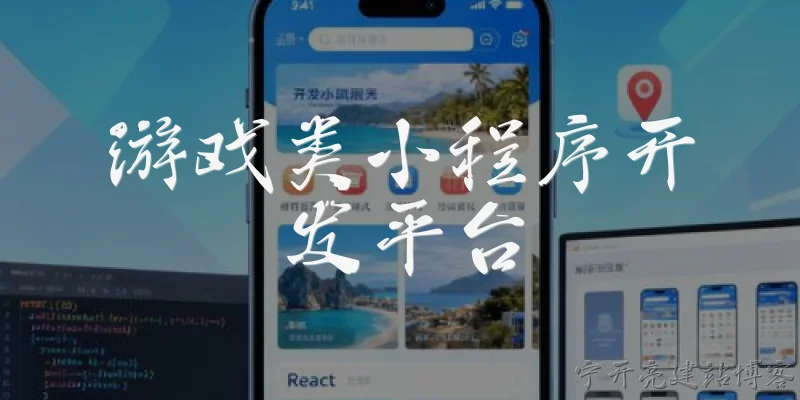
Game Mini Program Development Platform:What is a Game Mini Program Development Platform and how does it differ from traditional game development?
Q: What is a Game Mini Program Development Platform and how does it differ from traditional game development?
A: A Game Mini Program Development Platform is a specialized environment that allows developers to create lightweight games that run inside larger super-html">apps like WeChat, Alipay, or ByteDance's Douyin, without requiring users to download a separate html">app. Unlike traditional game development, which typically targets native iOS or Android html">apps or web browsers, mini program games operate within a sandboxed runtime provided by the host platform. This means developers must adhere to strict package size limits—often just a few megabytes—and use platform-specific APIs for rendering, storage, and payments. The development workflow is streamlined: you write code in JavaScript or a similar language, test it in the platform's IDE, and submit it for review. Distribution is instant because users access games via search, QR codes, or in-html">app recommendations. Monetization options include in-html">app purchases and rewarded ads, but revenue sharing with the host platform html">applies. Overall, the key differences are the constrained environment, the reliance on a single ecosystem, and the frictionless user acquisition that comes from being embedded in an already popular html">app.
Q: What are the key features to look for in a Game Mini Program Development Platform?
A: When evaluating a Game Mini Program Development Platform, prioritize features that streamline the unique constraints of mini games. First, a robust IDE with real-time preview, debugging, and performance profiling is essential, as it helps you catch issues before submission. Second, cross-platform compatibility matters: some platforms let you export to multiple super-html">apps (e.g., WeChat and Douyin) from one codebase, saving significant time. Third, check the available APIs for rendering, audio, networking, and device sensors—limited or outdated APIs can restrict gameplay. Fourth, look for built-in monetization tools, such as ad SDKs, in-html">app purchase support, and analytics dashboards, so you can track revenue and user behavior without third-party integrations. Fifth, consider the asset pipeline: efficient compression and loading of images, sounds, and fonts are critical given strict size limits. Finally, community and documentation quality can make or break your experience; an active forum and clear guides reduce development friction. Some platforms also offer cloud services for leaderboards or save data, which can be a bonus. Weigh these factors against your target audience and monetization goals.
Q: How do I choose the right Game Mini Program Development Platform for my project?
A: Choosing the right Game Mini Program Development Platform depends on your target market, technical requirements, and long-term strategy. Start by identifying where your audience spends time: if you're targeting China, WeChat Mini Games dominate with over a billion users, but Douyin and Alipay offer growing opportunities. Next, assess the platform's technical capabilities: does it support the game genres you plan to build? For example, real-time multiplayer may require WebSocket support, while hyper-casual games need fast load times and simple APIs. Consider the revenue model—each platform has different ad networks, payment gateways, and revenue-sharing terms. Also, evaluate the development cost: some platforms provide cross-platform frameworks that let you write once and deploy to multiple super-html">apps, which can be cost-effective but may limit access to platform-specific features. Finally, look at the html">approval process and update frequency; a lenient review process speeds up iteration, while strict policies can delay launches. Pilot your game on one platform, gather analytics, and then decide whether to expand. Remember that mini program ecosystems are walled gardens, so your choice affects user acquisition and monetization potential.
Dialogue about
Common scenarios of "Game Mini Program Development Platform"
【Product Manager】 Hey team, we need to finalize the requirements for our new game mini program development platform. We're targeting indie developers who want to quickly create and publish mini games. Any initial thoughts?
【Lead Developer】 I think the core should be a visual editor with drag-and-drop components. That would lower the barrier for non-coders. But we also need to support custom scripting for advanced users.
【UX Designer】 From a UX perspective, we should have a template gallery with popular game genres. Users can start from a template and customize. The interface needs to be intuitive, maybe with a guided tour.
【Product Manager】 Good. Let's prioritize the MVP features. What are the must-haves for the first release?
【Lead Developer】 For MVP: a canvas editor, a few basic game mechanics (like physics and collision), asset management, and one-click export to major mini program platforms like WeChat and Alipay.
【UX Designer】 Also, we need a preview mode so developers can test on their phones instantly. And maybe a simple analytics dashboard to track user engagement.
【Product Manager】 Analytics might be phase 2. But preview is essential. How about monetization? Should we integrate ad SDKs?
【Lead Developer】 Yes, we can provide plugins for ad networks. But that adds complexity. Maybe start with a basic ad integration for rewarded videos.
【UX Designer】 We should also consider collaboration features. Multiple developers working on the same project. Real-time editing like Google Docs.
【Product Manager】 That's a nice-to-have for later. Let's focus on individual developers first. What about performance? Mini programs have size limits.
【Lead Developer】 We'll optimize assets and use code splitting. The export should minify and compress everything. We can also offer a cloud build service to handle heavy lifting.
【UX Designer】 I'll start wireframing the editor interface. Should we include a component library with pre-built game objects like characters, obstacles, and power-ups?
【Product Manager】 Absolutely. That will speed up development. Let's also have a marketplace where users can buy and sell assets and templates. That could be a revenue stream.
【Lead Developer】 Marketplace requires a review system and payment integration. That's a lot. Maybe we can partner with existing asset stores initially.
【UX Designer】 For the editor, we need to decide on the layout. Left panel for assets, center canvas, right panel for properties. Bottom for timeline or console.
【Product Manager】 Sounds standard. Let's also add a tutorial section and community forum. Documentation is key for adoption.
【Lead Developer】 We'll need to document our scripting API thoroughly. Maybe use TypeScript definitions for autocomplete.
【UX Designer】 I'll design a dark mode as default, since game devs often prefer that. Also, keyboard shortcuts for common actions.
【Product Manager】 Great. Let's set a timeline. We need a prototype in 4 weeks, beta in 8 weeks, and launch in 12 weeks. Agreed?
【Lead Developer】 Agreed, but we need more resources for testing across different mini program platforms. Each has its own quirks.
【UX Designer】 I'll coordinate with the QA team to ensure cross-platform compatibility. Let's reconvene next week with detailed specs.